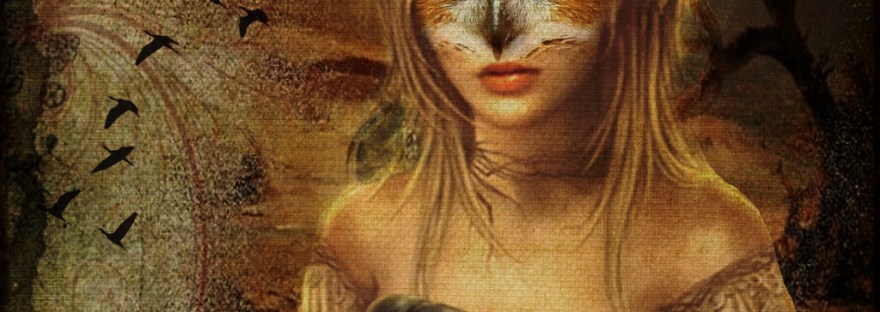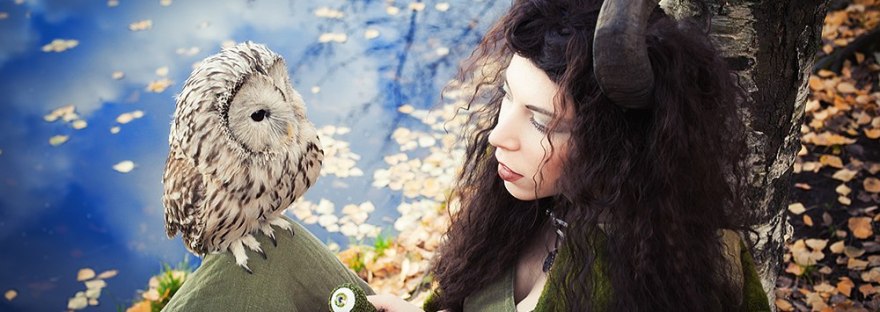
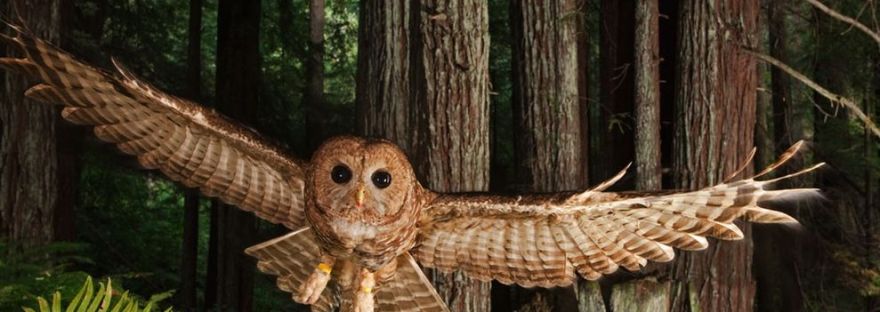
In the Pacific Northwest, Blodeuwedd's darker aspect manifests as innocent victim as well as hapless intruder. Not one or the other, but both. As the Spotted owl, we might experience Blodeuwedd as vulnerable, elusive and withdrawn, the unfamiliar Other who demands that we place our loyalty to her above our human concerns, who asks more of us than we are perhaps willing to give — the hag who demands a kiss as the price of sovereignty. As the Barred owl, she is the adaptable trickster again, the wanderer driven by hunger into new lands, whose appetite and determination threaten to overturn the current order. Seeing the owl in the goddess, we also see the goddess in the owl. Do we sacrifice the one in service to the many, without that one's consent? Do we kill this one owl, or eradicate this one species, for the sake of the balance and prosperity of the whole?
Category: Theology
The Goddess, the Broom and the Barred Owl, Part 3
How do we understand the innocence of Blodeuwedd as the Flower Maiden, and her punishment as the Owl-Faced Old Maid? In the web of life in which everything has a proper and harmonious place as part of a greater dynamic balance, those beings who wander aimlessly without place or purpose — or who refuse to submit to their fate as decreed by the greater order of things — can potentially pose a threat to that balance, causing disruption and harm in their desperate desire to survive. Love of life can lead us astray. In the utter innocence and fierce love of the goddess there exists a lurking danger, where wildness shades into chaos and disharmony. Blodeuwedd is a goddess created in the image of the human being, for a very human purpose: to love and be loved. And yet she retains (as do we all) the undeniable influences of the natural world from which she was made, a more-than-human world in which love and life-force intermingle and overwhelm as the indomitable eros of passion. She exists in a liminal state, very much like our own species. She is a goddess of exile and displacement, and for that reason she is also a goddess of invasion.
The Goddess, the Broom and the Barred Owl, Part 2
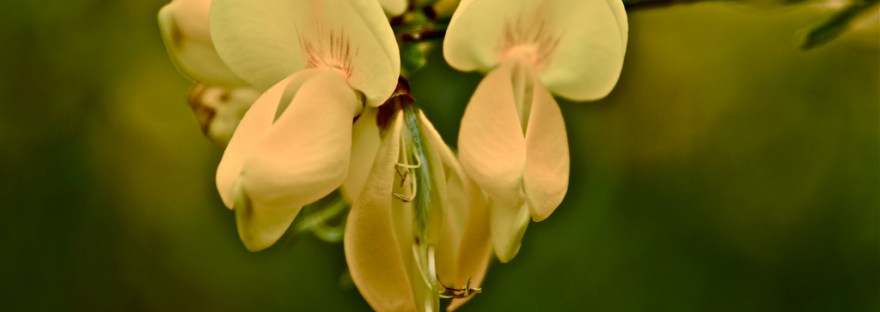
Blodeuwedd embodies the spirit of the trickster. She is herself literally the work of trickery and artifice. Her physical body is not a unity, but a cobbled-together assortment of twigs and blossoms given a kind of unnatural animation through the magic of Gwydion. And although she is designed by men far more powerful than she is for one specific purpose — to serve as Lleu's wife and queen — yet she thwarts that purpose through lies and deceit, following the call of her own hunger, her own passion and desire. As a result she is cursed, like so many other trickster figures, to aimless wandering in the wilderness, a social outcast. She is both subhuman and superhuman, both bestial and divine. She is the thief who steals away the beloved from the rightful king, except that it is her own self that she steals away — is this theft, or reparation? Either way, this is a goddess familiar with dislocation and disconnection, and one who embodies within her very being the ambivalence of human technology and how it mediates our relationship with the natural world.
The Goddess, the Broom and the Barred Owl, Part 1
As an animist, my relationship with the gods is rooted in my relationship with the land and its many beings. Yet so many of my gods are in exile from the lands of their origins. What does it mean for an American living in the Pacific Northwest to worship deities of Ireland and Wales? In part, it means that many of my gods are — like myself — pilgrims and strangers in a new world, still finding their feet and learning what it means to move in this new land with grace and respect. Their lessons today are often lessons of ambivalence, dislocation and longing. For me, no goddess has been more insistent in her teaching than the flower-faced maiden, Blodeuwedd. Who is Blodeuwedd? She is a goddess of dangerous innocence, an innocence so pure that it threatens to undo our easy assumptions about the world and our place within it.
The Nature of Fog
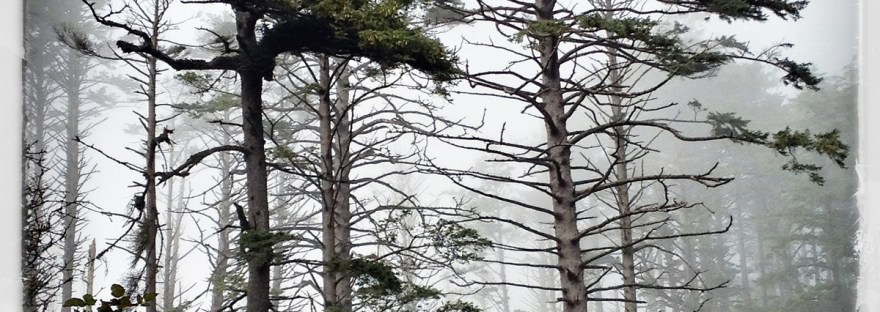
It's a quiet, foggy morning here in Seattle, and I'm thinking about ontology — the philosophical study of the nature of existence. There is something deeply dissatisfying about a choice between reductionism and hierarchy, for both seem to me equally wrong. Although in naturalistic philosophy hierarchy no longer needs the divine sanction of a god to justify it, the supremacy of human culture and human consciousness remains unchallenged, the assumed pinnacle of evolution, with the masses of quarks, quasars, oak trees and elephants relegated to the same old mindlessness of mere objects, only so much stuff. But rather than go into any more detailed analysis of these dense and sometimes unwieldy philosophies, instead I want to talk a little bit about fog...
The Pulse of Autumn
Why should our communion with the beloved dead depend on the coincidental turning of the Earth on its axis? Why should we not always be in touch with those who have crossed the threshold, in touch with our own mortality and death? One might as well ask why the angle of the sun should sometimes grace the crocuses and wet new buds of spring and at other times drop down heavy and hot into the deepest reaches of summer lakes, why childhood should burst with curiosity and buzzing movement and adulthood settle into the long, gentle pull of days one after another beneath a bright, cool sky. The truth is, I suspect, that there is no Other-world. That we live in this one world, together with the dead and the long-departed, drinking in the same gulps of breath as they once drank.
Why I Cannot Tell You About My Gods
When my friend Carl McColman says that language is tricky, and that God is bigger than the limits of the human mind, we might imagine our words are just so many rigged-up rubber bands, paper clips and packing tape with which we are, MacGyver-style, trying to capture a wild and mighty wind. Yet our words are our own breath given form by our body and its movements, and where else have we drawn that breath but from the winds themselves? Our speaking is a shaping of the wind within us, released back into the wild to work its way into someone else's body, moving with the ebb and flow of sound waves, pressing in against their eardrums, stirring the tiny hairs of their skin. To talk about language this way is to break out of the metaphor of objects and containers, and to see words as experiences in themselves.
Biophilia: On Love and Nature
Our relationship with nature gives rise to a paradox, in the same way that love creates a paradox. The paradox of love closely parallels the on-going struggle we have with the question of whether we are a part of nature, or separate from it. When we think of nature as our beloved, we discover that the answer is in fact: both. To be a nature-lover is to recognize this paradox: when we love nature, we see that our love both unites us with and differentiates us from what we love. In this way our love of nature affirms the most basic truth of our experience as self-aware creatures: that we are both a part of and apart from the world around us, that we are both whole individuals ourselves, and united in a whole that transcends our individuality.
Why (Not) Be a Christian? – The Oasis
Meeter gives Christianity a bit of a soft sell, emphasizing all of the ways that being a Christian can help you get your head right and find a more meaningful way of living. But what he doesn't do is justify, or even articulate, some of the foundational ontological beliefs on which he's based his arguments. Since the kind of god we worship affects the kind of human beings we are, let's see if we can't find out a bit more about Meeter's god by looking at the kind of human he inspires.
Why (Not) Be a Christian?
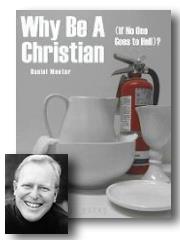
Why be a Christian (if no one goes to hell)? That might seem like an odd question for a Pagan Druid to be asking, but it's the title of a new book by Daniel Meeter that caught my eye.* I like to take up these challenges every now and then, in part because remembering the religious tradition that I came from helps to remind me why I left, and what lessons or insights of value I want to hold onto and carry with me into the future, even if I no longer call myself a Christian. After all, I remember being a Christian. In fact I was, if I may say so, a really fantastic Christian. I Christianed the hell out of that shit. So what happened? It's a long story (with a few twists and turns). Suffice it to say, I'm in a different place in my life now, and that place gives me a different perspective on the purpose of the spiritual life and the assumptions we bring to it. That's why I wanted to read Meeter's book. To stretch my muscles a bit, to remember what it's like to think about the world differently, and to keep my interfaith work bilingual and useful.