Deep Ecology, Featured, Holy Wild, Theology

The Goddess, the Broom and the Barred Owl, Part 1

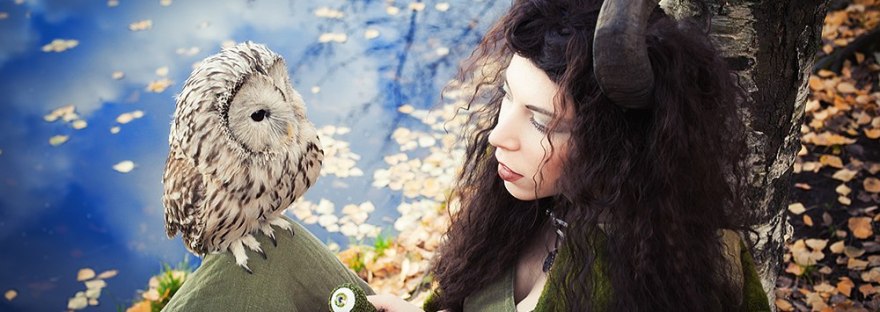
As an animist, my relationship with the gods is rooted in my relationship with the land and its many beings. Yet so many of my gods are in exile from the lands of their origins. What does it mean for an American living in the Pacific Northwest to worship deities of Ireland and Wales? In part, it means that many of my gods are — like myself — pilgrims and strangers in a new world, still finding their feet and learning what it means to move in this new land with grace and respect. Their lessons today are often lessons of ambivalence, dislocation and longing. For me, no goddess has been more insistent in her teaching than the flower-faced maiden, Blodeuwedd. Who is Blodeuwedd? She is a goddess of dangerous innocence, an innocence so pure that it threatens to undo our easy assumptions about the world and our place within it.
Holy Wild, News & Announcements

Signal Boost: Be Part of the Animist Blog Carnival!

Every month, the Animist Blog Carnival (organized by the devoted Heather Awen) gathers together essays and blog posts on a particular theme from writers all over the world who are exploring animism as an aspect of their spiritual lives. If you consider yourself an animist, you can join in! It's super-easy: just share your reflections, thoughts and experiences on the month's chosen theme on your own blog or website, and then email a link to your post to Heather (or that month's ABC host). And now's a great time to get involved. The theme for this month's ABC is Animism and Religion, and Heather shares a list of thought-provoking prompts over on her blog to get you started. Deadline: November 28, 2013

Deep Ecology, Holy Wild, Theology

The Nature of Fog

It's a quiet, foggy morning here in Seattle, and I'm thinking about ontology — the philosophical study of the nature of existence. There is something deeply dissatisfying about a choice between reductionism and hierarchy, for both seem to me equally wrong. Although in naturalistic philosophy hierarchy no longer needs the divine sanction of a god to justify it, the supremacy of human culture and human consciousness remains unchallenged, the assumed pinnacle of evolution, with the masses of quarks, quasars, oak trees and elephants relegated to the same old mindlessness of mere objects, only so much stuff. But rather than go into any more detailed analysis of these dense and sometimes unwieldy philosophies, instead I want to talk a little bit about fog...

Featured, Holy Wild, Theology

The Pulse of Autumn

Why should our communion with the beloved dead depend on the coincidental turning of the Earth on its axis? Why should we not always be in touch with those who have crossed the threshold, in touch with our own mortality and death? One might as well ask why the angle of the sun should sometimes grace the crocuses and wet new buds of spring and at other times drop down heavy and hot into the deepest reaches of summer lakes, why childhood should burst with curiosity and buzzing movement and adulthood settle into the long, gentle pull of days one after another beneath a bright, cool sky. The truth is, I suspect, that there is no Other-world. That we live in this one world, together with the dead and the long-departed, drinking in the same gulps of breath as they once drank.

Muse in Brief

The Speed of Blood » No Unsacred Place

In my latest post over on No Unsacred Place, an illness that leads to a hospital visit has me reflecting on questions about the relationship between health, healing, body and spirit and how we experience moments of transcendence even in the midst of danger: "If it weren't for these strange experiences of transcendence, I might be a pure animist. When I feel the wind caress my skin and it seems to me to be living and animate, filled with purpose and awareness — I cannot divide that sense of Presence from the wind itself. ..."

Holy Wild, Theology

Gods and Spirit

That word for god — the breath, the gleaming — the shining days like great columns bearing up the sky, buttresses, rafters. Beams that in their falling, hold. I say the names of my deities, I feel the drop of each sound into silence. They gather on the long, bent grasses in the meadow and the field, *dewos-, the many that glisten in the coming dark. Amulets of sky, jewels of the daylight, coalescing in the movement of my breath, the lingering touch of the wind. They draw themselves, wavering, into the weight and gravity of form. I open the door, and the gods enter the dark interior of my being.

Contemplation & Meditation, Holy Wild

Silence in the Trees

Tonight, reading David Abram's musings on the language of our embodied selves and this thickly expressive world in which we live, I wonder about the internet. As my friend Cat has taught me, the Quakers have a saying: "This Friend speaks to my condition." The Quaker Meeting is one of silence and unfolding into Spirit. When a Friend speaks in Meeting, it is with Spirit moving through them. The breath is Spirit in the flesh, and when it stirs, the Friend opens and allows the music of Spirit (the Song of the World, as we Druids call it) to rise up and overflow.

Holy Wild, praxis, Theology

Contemplations on Polytheism and Gods of the Land

When I began exploring polytheism, I began to understand that the monism underlying some Pagans' conception of Spirit did not jive with my experiences and observations. If I believed in the intimate relationship between the material, physical world and the spiritual world that was its home and source, it seemed unlikely that the embodied world could be so varied, mottled and marvelously complex if the nature of Spirit was a kind of homogenous, undifferentiated aether or spiritual soup. So the beginnings of my own polytheistic theology was this idea of the many-in-the-One, the "ecology of Spirit." This was an ecosystem of living and interrelated beings, some embodied in all the unique ways that embodiment brings, and some just as unique without the solid weight...