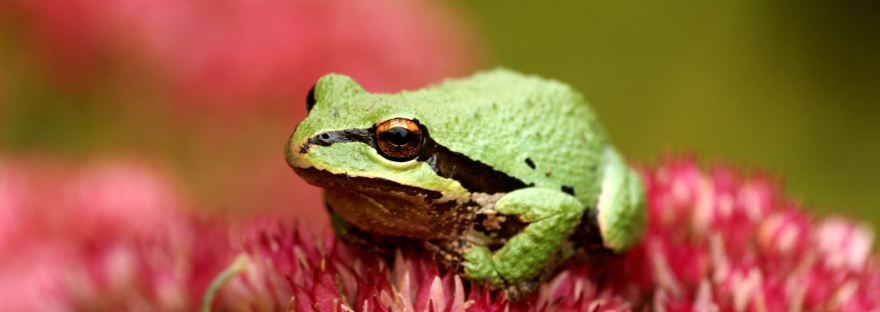
We hear the song long before we reach the pond itself ― the rolling, rhythmic voices rising up from among the grasses all around us as if we have entered the halls of some vast monastery during evening prayer. The thrum washes over us in the darkness. We step carefully, sweeping our flashlights back and forth across the path. The kids are tense with eager excitement for the hunt, whispering questions at each unfamiliar noise, flicking their flashlights over every stray stone or lump in the grass hoping to catch a glimpse of movement ― the flexing muscular limbs or the bulging throat of a frog. But there are too many of us. By the time we've reached the water's edge, the low chanting voices have dropped away and the whole place has fallen into silence.
Category: Featured
Daring to Dream: An Imbolc Family Adventure
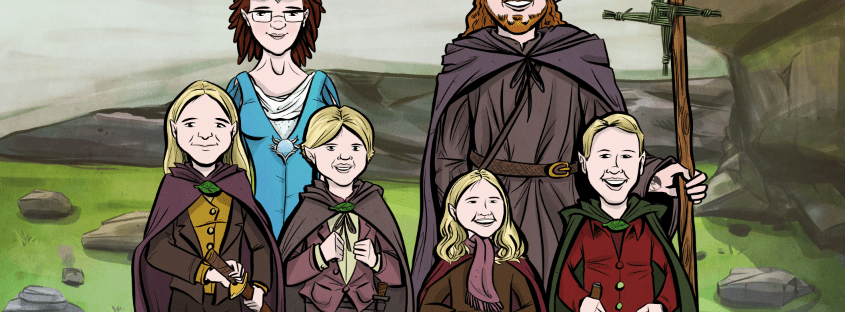
It all started this past winter solstice when Jeff's youngest daughter told us that she was going to be a dentist. Actually, what she said was that she guessed she'd have to be a dentist, because everybody knows you can't make a living as an artist. Our heads kind of exploded at that point, so what happened next was a bit of a blur. I vaguely remember sitting her down at the kitchen table and asking her why this sudden about-face -- she'd been talking about wanting to be an artist for the last several years which, for a nine-year-old, is almost a lifetime. I remember treading carefully, lest I inadvertently suggest that being a dentist wasn't perfectly okay, too, if that's what she really wanted. The world needs good dentists, after all. But what the world doesn't need is a grumpy, jaded dentist who's secretly always wanted to be an artist instead. That doesn't end well for anyone.
Gods Like Mountains, Gods Like Mist
My gods are not tame. They do not always come when they are called. This is not a failure of ritual or a weakness of belief. It is the nature of my gods. I would no more expect a god to "show up" in my ritual space than I would expect to be able to call a mountain into my living room. That is simply not the nature of mountains. If I want to meet a mountain, I am the one who must move. Because I do not believe that humans are the only beings with agency in the world, I do not expect my gods to express their agency in the same ways that human beings do. There are gods who forever remain elusive, whose identities shift with the landscape, the seasons and the stars. And there are gods so intimate that they are never really absent at all, and meeting them is not a matter of inviting their presence but rather of quieting my own expectations and learning how to listen. There are gods whose presence looms like a mountain range on the horizon, and gods with(in) whom I walk with grace, my footsteps just one more melody in the great pattern of their being. What does hospitality look like to a mountain? How does a forest speak its mind? What does it mean to invoke a god of mist and sea on a mist-strewn shore?
The Goddess, the Broom and the Barred Owl, Part 1
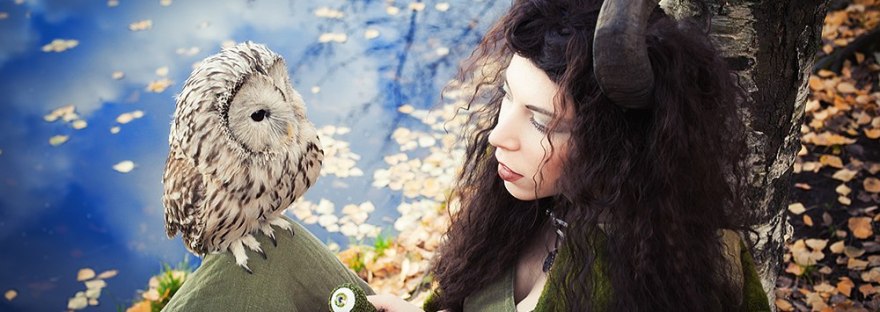
As an animist, my relationship with the gods is rooted in my relationship with the land and its many beings. Yet so many of my gods are in exile from the lands of their origins. What does it mean for an American living in the Pacific Northwest to worship deities of Ireland and Wales? In part, it means that many of my gods are — like myself — pilgrims and strangers in a new world, still finding their feet and learning what it means to move in this new land with grace and respect. Their lessons today are often lessons of ambivalence, dislocation and longing. For me, no goddess has been more insistent in her teaching than the flower-faced maiden, Blodeuwedd. Who is Blodeuwedd? She is a goddess of dangerous innocence, an innocence so pure that it threatens to undo our easy assumptions about the world and our place within it.
In Praise of Boring Sex
I wasn't exactly having any raging hot sex in my mid-twenties. What intimacy there was to be snatched between caffeine-addled swing shifts was difficult and desperate, and always over too soon. Why should love be so hard? The world seemed full of impervious surfaces -- concrete, steel and glass -- against which there was nothing to do but rip myself ruthlessly open to the possibility of contact. To make the foolhardy choice to stay soft and tattered; to refuse to be ground smooth into something polished, invulnerable, inhuman. To choose, each time, to throw myself once more into the harsh, cold waters where the restless waves broke against the rocks. Which might be why, these days, I am still so often surprised by the utter heart-wrenching gentleness of quiet, boring sex. It is a blessing I am still getting used to.
The Pulse of Autumn
Why should our communion with the beloved dead depend on the coincidental turning of the Earth on its axis? Why should we not always be in touch with those who have crossed the threshold, in touch with our own mortality and death? One might as well ask why the angle of the sun should sometimes grace the crocuses and wet new buds of spring and at other times drop down heavy and hot into the deepest reaches of summer lakes, why childhood should burst with curiosity and buzzing movement and adulthood settle into the long, gentle pull of days one after another beneath a bright, cool sky. The truth is, I suspect, that there is no Other-world. That we live in this one world, together with the dead and the long-departed, drinking in the same gulps of breath as they once drank.
Nature and the Awe of Childhood
Maybe I was a weird kid, more enamored, more sensitive than most, and as I've grown up, my perspective has changed and evolved. But that this is true only convinces me all the more of how important it is to appreciate the diversity of experiences and the many voices that strive to share them, and not to be too quick to dismiss certain experiences or perspectives as less valuable or insightful than others. Is there only one way to appreciate nature? I can't believe there would be just one.
Invasives: Enemies or Allies?
Given how harmful an invasive species can be, it's tempting to see them as wholly bad, the "enemy" of a healthy ecosystem that needs to be eradicated. For modern Pagans seeking to live an embodied spirituality grounded in the sacred land, invasives are powerful allies in coming to terms with our own ambivalent role in the ecosystems we inhabit, and the possibilities and choices that lie before us. Too often our modern society encourages us to see nature as fragile and untouchable, and humans as the worst intruders of all. Befriending invasives can teach us valuable lessons about how to be respectful, loving citizens of the planet that we call home.
Biophilia: On Love and Nature
Our relationship with nature gives rise to a paradox, in the same way that love creates a paradox. The paradox of love closely parallels the on-going struggle we have with the question of whether we are a part of nature, or separate from it. When we think of nature as our beloved, we discover that the answer is in fact: both. To be a nature-lover is to recognize this paradox: when we love nature, we see that our love both unites us with and differentiates us from what we love. In this way our love of nature affirms the most basic truth of our experience as self-aware creatures: that we are both a part of and apart from the world around us, that we are both whole individuals ourselves, and united in a whole that transcends our individuality.
Anatomy of a God
We want so very much to understand our gods, to know them intimately, to see how they work in our lives. It is tempting to dissect, to analyze, to categorize. And sometimes, it is necessary, even beneficial. We are categorizing creatures, we human beings. We pick out patterns as a matter of survival. When it comes to our gods, we reach for them not only with our prayers and offerings, but with our reason and our intellects — we would know them with our whole selves, in all their parts, in part so that we might know our own selves better in all our parts. The challenge is to delve into theology without killing its subject, to try our hand at analysis and critical thinking without pretending that the numinous divine is a dead thing that will hold still beneath our careful knives. Theology is not dissection. It is much more gruesome than that; it is vivisection.