Our relationship with nature gives rise to a paradox, in the same way that love creates a paradox. The paradox of love closely parallels the on-going struggle we have with the question of whether we are a part of nature, or separate from it. When we think of nature as our beloved, we discover that the answer is in fact: both. To be a nature-lover is to recognize this paradox: when we love nature, we see that our love both unites us with and differentiates us from what we love. In this way our love of nature affirms the most basic truth of our experience as self-aware creatures: that we are both a part of and apart from the world around us, that we are both whole individuals ourselves, and united in a whole that transcends our individuality.
Tag: ecology
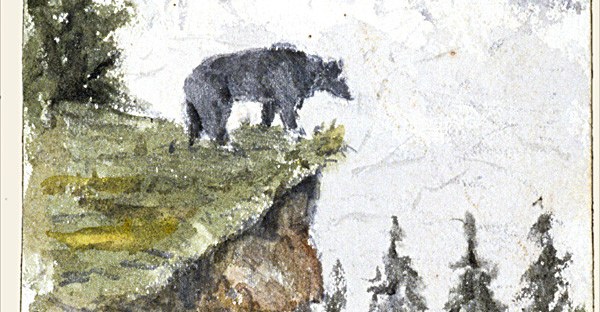
Bear: Companion of Winter
Not all of our companions will elbow their way into our lives and demand our attention. Some of them linger beyond the limits of our ordinary experiences, leaving only footprints and snapped twigs as traces of their presence. These are our guides to the depths of mystery and wilderness. They are dark wanderers who cross our paths only in the obscurity of a moonless night, whose form we seem to see only just on the periphery of our vision before it dissolves again into the tangled undergrowth of the unknown. They are the companions whose presence we sense with the thrill of uncertainty, that mixture of excitement and terror that gives rise to awe. Their breath is the sound on the edge of hearing that we catch just when we think we are alone. Lest we forget that nature is not only familiar and intimate, but deeply wild and strange. Lest we forget that some things are hidden, and will remain hidden. The bear is, for me, this kind of companion.
Anatomy of a God
We want so very much to understand our gods, to know them intimately, to see how they work in our lives. It is tempting to dissect, to analyze, to categorize. And sometimes, it is necessary, even beneficial. We are categorizing creatures, we human beings. We pick out patterns as a matter of survival. When it comes to our gods, we reach for them not only with our prayers and offerings, but with our reason and our intellects — we would know them with our whole selves, in all their parts, in part so that we might know our own selves better in all our parts. The challenge is to delve into theology without killing its subject, to try our hand at analysis and critical thinking without pretending that the numinous divine is a dead thing that will hold still beneath our careful knives. Theology is not dissection. It is much more gruesome than that; it is vivisection.
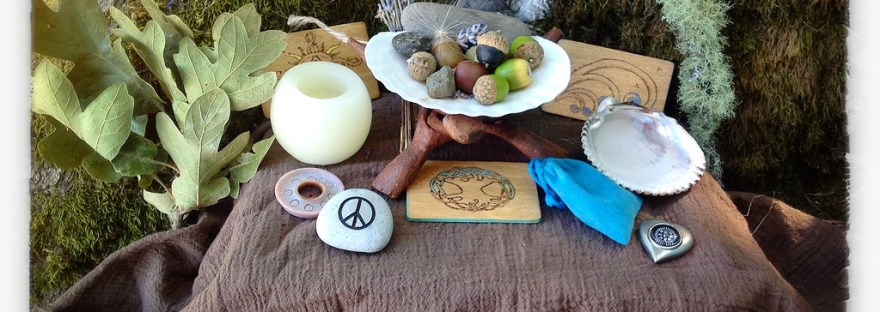
Adventures in Natural Polytheism: A to Z
What is ecological polytheism? That was the question that I knew I'd eventually have to answer. There was something going on in the root-webbed dark, some new kind of way of being Pagan that was starting to take shape for me. I tried to answer this question, or at least articulate it, in a couple of posts over on No Unsacred Place, and they became two of the most popular posts on the blog. I wasn't the only one interested in asking these kinds of questions, it seemed. Lots of other people were wondering the same thing. What is natural polytheism? How does ecology inform my theology? How can I bring science and religion into conversation for a more grounded and earth-centered Paganism?
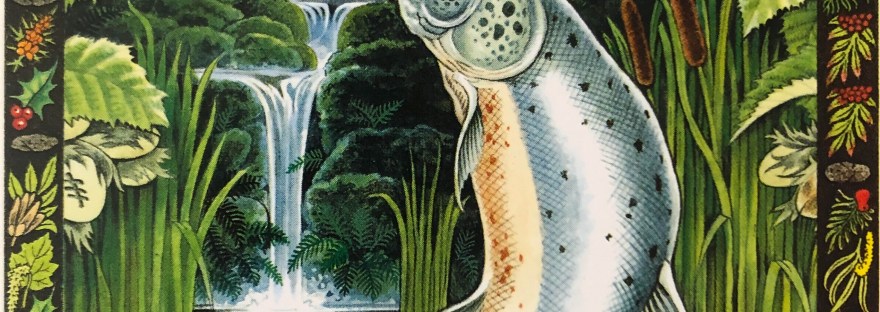
Salmon, Pagan Stewardship and the Lesson of Samhain
For me, Salmon has claimed her place along the year's wheel at Samhain-tide. The salmon run at Piper's Creek begins by the first day of November and lasts as late as the winter solstice. It is a time of cool, steady rain, a time of death and consummation. It is the in-between time, just after the Celtic New Year, but before the dawn of lengthening days. A time when new life begins in the dark, buried beneath the gravel of the streambed, invisible and silent. I think in many ways, modern Paganism is in this twilight time before rebirth as well. Seeded and kept alive from generation to generation after two millennia of broken traditions and scattered, assimilated cultures. We strive to root our traditions in the land, in a sense of place and in the presence of earth, but the social systems upstream don't make it easy.
Natural Theology: Polytheism Beyond the Pale » No Unsacred Place
In my latest post over on No Unsacred Place, I explore in more detail what it means to take an ecological approach to polytheism through the concept of "natural theology," and the kinds of tough questions that this kind of inquiry might challenge us to ask: "Ecology does not reject the hard sciences that came before it, but brings together and expands upon them. In this same way, natural polytheism draws on an ecological approach to theology to build upon the insights of hard polytheism, challenging us to deepen our relationships with the gods by asking more challenging questions about their relationships with us, with each other and with the natural world. ..."
Naming the Water: Human and Deity Identity from an Earth-Centered Perspective » No Unsacred Place
In my latest post over on No Unsacred Place, I respond to Teo Bishop's recent musings over at Bishop in the Grove, in which he contemplates hard polytheism and ancestor reverence, and the problematic issues of self-identity that might arise when we imagine our descendants worshipping us as gods: "As a Pagan, my theology is rooted firmly in the earth. To me, the earth is sacred, and so the ecological truths that guide and shape life on this tiny blue marble are sacred truths. One of those truths is that identity is fluid. I can no more name the discrete entity that is “me” than I can name the water flowing in a river. From moment to moment, that identity changes. This was the insight of the Buddhists, too: we are not the same person from one second to the next, and reincarnation is less like viscous soul-substance getting sloshed from one meat-container into the next as it is like a flame passing from one wick to another. Is it the same flame? Yes… and then again, no. ..."
Earth, Ecology and Environmentalism: Walking the Walk
There are more of us out there than you think. We may not always be flashing our Pagan flair — sometimes we're wearing worn old hiking books and mud-spattered rain coats instead of shimmering ceremonial robes, sometimes we put aside our pentacles and wands for a good pair of binoculars and a sturdy walking stick — but we're out there. Walking the walk. Doing the work.
Muse in Media: Disturbing Gentleness
Timothy Morton, author of Ecology Without Nature and The Ecological Thought, is attending the conference on Eastern and Indigenous Perspectives on Sustainability and Conflict Resolution at the University of South Florida this week and has done those of us philosophy-grad-student wanna-bees an amazing service by making the audio recording and slide show of his talk, Disturbing Gentleness, available on his blog. Morton's understanding of nonviolence resonates deeply with my own. It is not a passivity or denial of violence and death, but something that arises from and gives rise to existence itself. We are inconsistent beings, and the rift within our very selves is what allows for movement, spaciousness, beauty and death. Nonviolence is simply allowing this inconsistency in ourselves, and others, without trying to reduce it or extrapolate away from it. In this sense, perhaps the deepest expression of nonviolence is acceptance of things as they are — it is in fact the very opposite of denial.
Ambivalence of the Sacred Earth » No Unsacred Place
In my first post over at the new Pagan Newswire Collective blog project, No Unsacred Place: Earth and Nature in Pagan Traditions, I explore the Problem of Justice from an earth-centered perspective, and discuss its implications for the new Law of Mother Earth set to pass in Bolivia establishing the rights of nature: "The Problem of Justice for us is not so much why [suffering and evil] exist, but how should we respond to them? While monotheists might model themselves after an all-loving but ultimately transcendent deity who provides an example of justice and righteousness separate from and beyond the muck and mess of the world, our desire to 'attune ourselves to the earth' and model ourselves..."