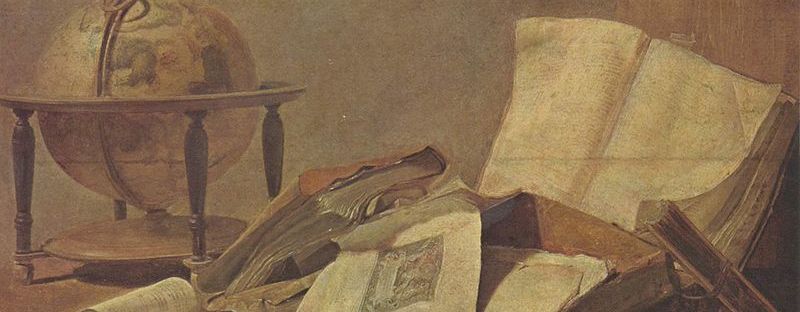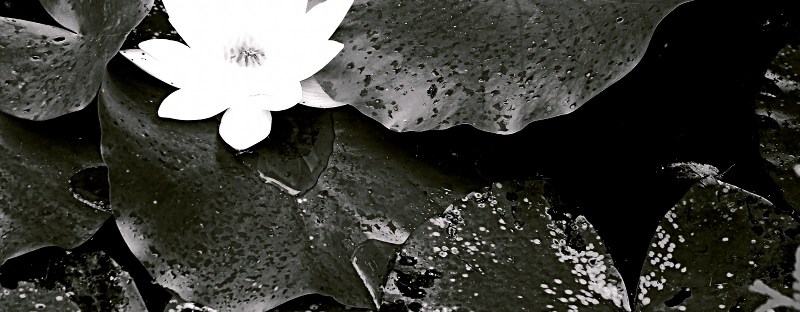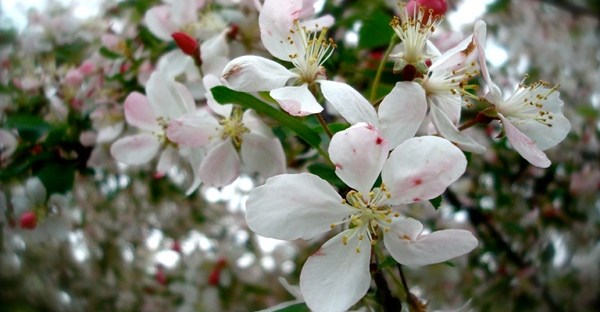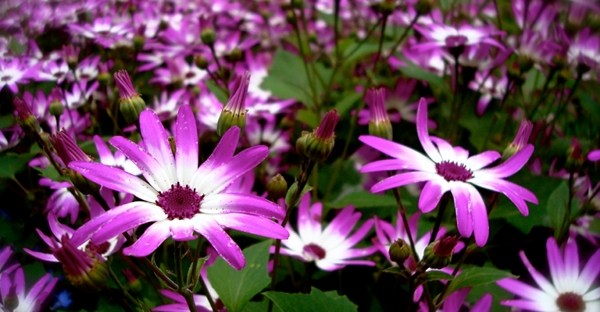
Today is Mother's Day (have you called your mother yet?). In honor of the Great Mother of us all, here's a beautiful slideshow of Mama Earth art, set to a chant performed by the Libana Music Ensemble.
The Earth is our Mother, we must take care of Her
Hey yana, ho yana, hey yan, yan
Click to watch.
Category: Holy Wild
Webbing the Whole Wide World
It's pretty cool to see that I have readers in places like Moscow (Russia), Shenzhen (China), Sydney (Australia), Jiddah (Saudi Arabia), La Paz (Bolivia), and even Nairobi (Kenya). Though that last one might have just been Peter. Obviously, the vast majority of my readers live in the United States (tied for second: Canada and the UK). I have readers in 42 of the 50 states. Only 42?!, you ask. I know, right?
Why Aren’t I Happy He’s Dead?
When I look at my own response — even the immediate, uncensored emotional response I had when I first heard the news — there is not even a trace of relief or joy. Bewilderment, yes. But honestly, more than a little bit of cynicism and scorn, as well. There's a part of me that immediately began to wonder what the "game" was that the government was playing this time, how they would turn the event to their advantage, and to what extent the killing of bin Laden was carefully orchestrated for calculated purposes. The seeming rush to dispose of the body, the lack of evidence or corroborating story from any sources outside the U.S. government, and now the rapidity with which the "official story" seems to keep changing, sparked my inner Conspiracy Theorist.
body politic | A Sonnet
body politic noun : (1) human organ of many heads ; tongues swarming from them [ as in, unison of insects ] ; hands, tangled beds of nails on which to rest evenly so as to spread weight, pressure without injury : (2) threat posed by ground swellings ; manifestation of projected intent to harm [ as in, the body of our enemy is dead, but not his intention ] : (3) the myth of history (archaic) [ ‘twas his own love that killed this shepherd, not our need to kill, and we remain innocent ] ; public will ; institutionally anointed gore to ensure death passes over our door
Coming Out & Going Down
What has changed in my spiritual life has little to do with the labels I give it. Today I am a Pagan Druid, but that may change in the future as the words evolve in meaning and the community that embraces them shifts and turns about itself in an on-going conversation of creative group-identity formation. What has changed for me, most importantly, is not the name for my spiritual practice, but its depth. I've never really had to "come out" as Pagan to anyone, because my spiritual life is not really about fitting into boxes, or broom closets — it's about deepening. I deepen into my self and my work, through prayer and meditation, through poetry and story, through my time in the woods and my attention to the landscape.
Muse in Media: Blessed Beltaine!
Just in case yesterday's post was a bit too serious for you — how about we lighten things up a bit? Every year, I manage to get this stuck in my head! A fantastic song by Jonathan Coulton about the coming of spring.... if you know what I mean. ::nudge::nudge::wink::wink:: Click to watch.
Ecstasy of Beltaine: Reflections on Love and Transgression
The significance of Beltaine reaches beyond merely being an agricultural festival focused on fertility and fecundity in service to the community, with romance acting as a bit of grease we can indulge in now and then to keep the Wheel turning. The holy day at the height of spring is also a day of ecstasy in the original sense, a day on which the attraction of life-force can pull us beyond ourselves and into communion with a larger Mystery, beyond tensions that might keep us too rigidly locked into unhealthy or hampering community bonds once they have outlasted their benefit. Along with Samhain, the other hinge of the year, Beltaine serves as a liminal time, a time of thresholds and permeable boundaries. The great ecstatic mysteries of sex and death dominate both these holy days.
Quote of the Week
"The room where I live is plain as a skull, a firm setting for windows. A nun lives in the fires of the spirit, a thinker lives in the bright wick of the mind, an artist lives jammed in the pool of materials. (Or, a nun lives, thoughtful and tough, in the mind, a nun lives, with that special poignancy peculiar to religious, in the exile of materials; and a thinker, who would think of something, lives in the clash of materials, and in the world of spirit where all long thoughts must lead; and an artist lives in the mind, that warehouse of forms, and an artist lives, of course, in the spirit. So.) But this room is a skull, a fire tower, wooden, and empty. Of itself it is nothing, but the view, as they say, is good."
- Annie Dillard, from Holy the Firm
Welcome, World!
As both Rumi and T. Thorn Coyle have said, you must ask for what you really want. What I want, and what I've wanted for as long as I can remember, is to be a writer, and to share my writing with a community of engaged and interested readers. Sometimes that seems like a really easy goal: all I need is a computer or, if we're getting really rugged and old school, a pen and some paper. Other times, it feels like the most difficult, intimidating and impossible goal in the world. I care passionately about all the work that I do and all the writing I share, and the fear of being overlooked, unsupported, misunderstood or laughed at can loom large in my peripheral vision. But eventually I realized that if I'm not ready to stand up and brag about my work, to shout my enthusiasm and excitement from the rooftops — then why should I expect anyone else to?
Pagans and Nonprofits
I seem to be making a few gentle waves in that fine, dry wine I mentioned last week. My article, "Balancing Liberty and Law: Religious Nonprofits in America and Britain," published on Patheos.com last Thursday, was cited extensively today in an article in The Nonprofit Quarterly (and subsequently picked up by Jason Pitzl-Waters over at The Wild Hunt). NPQ reporter Rick Cohen writes: "Typically, debates about the tax treatment of faith-based organizations and of churches involve well-known and recognized religions - Christianity, Judaism, Islam, Hinduism, Buddhism, etc. – and sometimes debates..."