The Lilly Family Fellowship
art, Featured, Holy Wild

Daring to Dream: An Imbolc Family Adventure

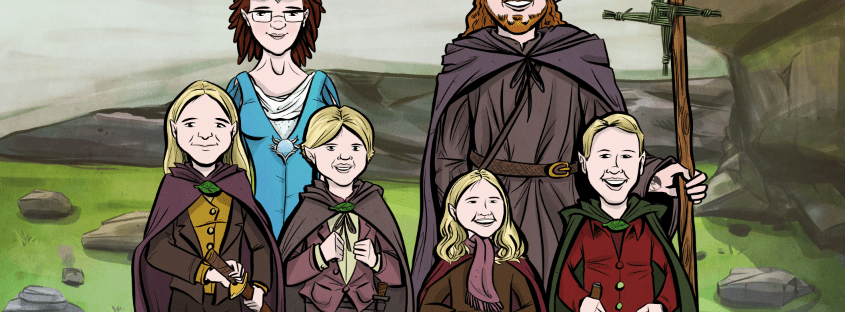
It all started this past winter solstice when Jeff's youngest daughter told us that she was going to be a dentist. Actually, what she said was that she guessed she'd have to be a dentist, because everybody knows you can't make a living as an artist. Our heads kind of exploded at that point, so what happened next was a bit of a blur. I vaguely remember sitting her down at the kitchen table and asking her why this sudden about-face -- she'd been talking about wanting to be an artist for the last several years which, for a nine-year-old, is almost a lifetime. I remember treading carefully, lest I inadvertently suggest that being a dentist wasn't perfectly okay, too, if that's what she really wanted. The world needs good dentists, after all. But what the world doesn't need is a grumpy, jaded dentist who's secretly always wanted to be an artist instead. That doesn't end well for anyone.
Deep Ecology, Holy Wild, Theology

Anthropocentrism and Animal Instinct

Where does our anthropocentrism come from? Some scientists cite evolutionary pressures as one possible influence among many. But others point to instinctual cognitive processes to explain just the opposite, suggesting that the anthropocentric worldview is actually a rejection of the human instinct, not its inevitable consequence. Even if anthropocentrism isn't instinctual, for many of us it is deeply ingrained. To a man with a shovel, it can be hard to imagine any other solution but to keep digging our way out of this anthropocentric hole we find ourselves stuck in. Western society has spent a long time convincing us that the shovel is the only effective tool we have. Are there alternatives? How do we learn to think beyond the biases of anthropocentrism and reconnect with the more-than-human world?

Deep Ecology, Holy Wild, Theology

Defining Anthropocentrism

What is anthropocentrism? Turns out, there is no single, simple answer to this question. (Just among the nearly fifty books on environmental ethics and deep ecology that I have, only one actually offers a definition of the term, despite almost all of them referring to it in their discussions. As with many words, its meaning often has to be teased out and inferred from context.) In my earlier post I hinted at the beginnings of a definition when I referred to an approach to ritual that "takes for granted a worldview in which humans are the only measure of what is real." The question of how our idea of "the real" and our practical responses to it (for instance, through ritual activity) influence our underlying values and where we locate (or create) meaning is a complex conversation in its own right, and it is in this particular theological meadow that I'll do much of my lingering and bee-gazing in the following posts. But for now, it's probably more helpful to sketch out a basic definition, one we can use as a kind of measure against which we can hold up more complex, fidgety ideas later in the conversation...

Deep Ecology, Holy Wild

Talking about Anthropocentrism in Modern Paganism

On the same day I published "Gods Like Mountains, Gods Like Mists," Irish animist Traci Laird also shared a piece in which she confronted the issue of anthropocentrism in modern Western Paganism more directly. She points out, very rightly I think, that "the belief that human-persons are the most significant species on the planet, plays out within paganism in subtle and tricky ways." The response to our two posts has been incredibly varied, with writers across the Pagan blogosphere grappling with notions of anthropocentrism that range so widely at times it seems they're hardly talking about the same thing at all. The more responses and reactions I read over the past couple weeks, the more I realized that the issue of anthropocentrism in Paganism is incredibly complex and at times very confusing. Subtle and tricky ain't the half of it! And so I wanted to spend some time teasing apart some of these ideas about anthropocentrism and anthropomorphism in Pagan ritual and theology.

Holy Wild, Muse in Brief

Of Apples and Awen. . .

It's been two weeks since my piece "Gods Like Mountains, Gods Like Mists" set off a fascinating and wide-ranging discussion about anthropocentrism in polytheist ritual and theology. In case you were wondering — yes, I've been busy reading, thinking, digesting and working on a follow-up post (or six!) of my own that I'll be sharing here soon. In the meantime, I wanted to point out some amazing writing elsewhere in the blogosphere. Featuring posts by Sara Amis, Joanna van der Hoeven, Heather Mingo and more!

Holy Wild, Rite & Ritual

Frost and Stone: Grounding Energy in Winter’s Dark

There is ice in old Earth Mother's blood these days, and everywhere the ground is as hard as unyielding stone. The winds are biting cold. The sunlight, though still low on the horizon, is bright and sharp. It glints off the edges of every surface, refracted, scattered in a thousand directions. I sit in the shadow of a great evergreen tree outside, struggling to root, straining to bring the manic energies back into balance. The whole world seems to be cold fire and frenzied air. This won't do. I have to find another way...

Earth Wind Water, by Christopher Beikmann
Deep Ecology, Featured, Holy Wild, Theology

Gods Like Mountains, Gods Like Mist

My gods are not tame. They do not always come when they are called. This is not a failure of ritual or a weakness of belief. It is the nature of my gods. I would no more expect a god to "show up" in my ritual space than I would expect to be able to call a mountain into my living room. That is simply not the nature of mountains. If I want to meet a mountain, I am the one who must move. Because I do not believe that humans are the only beings with agency in the world, I do not expect my gods to express their agency in the same ways that human beings do. There are gods who forever remain elusive, whose identities shift with the landscape, the seasons and the stars. And there are gods so intimate that they are never really absent at all, and meeting them is not a matter of inviting their presence but rather of quieting my own expectations and learning how to listen. There are gods whose presence looms like a mountain range on the horizon, and gods with(in) whom I walk with grace, my footsteps just one more melody in the great pattern of their being. What does hospitality look like to a mountain? How does a forest speak its mind? What does it mean to invoke a god of mist and sea on a mist-strewn shore?

Standing Tall, (CC) Jaina
Holy Wild, praxis

What Resolution Really Means

Because I'm such a Hipster Pagan that I've come full circle, in recent years I've stopped disparaging New Year's Resolutions for being "too mainstream" and decided to re-embrace the practice. After all, the word resolution is a vast and complex universe in itself. Like words such as integrity, balance and attention, resolution can mean many things, and spending some time considering its nuances bears some surprising (and surprisingly delicious) fruit. So for those of you who might be on the fence about making resolutions for the coming year, here are some thoughts on what resolution means to me.

Holy Wild, Rite & Ritual, story

A Ha’penny Will Do: A Pagan Perspective on Christmas

As Christmas approaches once again, I find myself wondering, wandering in a liminal space. Asking myself how to teach children that realizing their own inner Santa Claus is infinitely more challenging than believing in some unlikely literal jolly-old-elf, and infinitely more rewarding. Asking myself where I belong, where we all belong, and how we belong to each other. Asking myself how I can tell the stories of my ancestors, pagan and Christian alike, to the children of my partner. What can I say that will be meaningful and relevant for them, that will share with them the "spirit of the season" that I have come to know and love and value? What will I say when they come singing, a penny for my thoughts?

Deep Ecology, Holy Wild, Theology

The Goddess, the Broom and the Barred Owl, Part 5

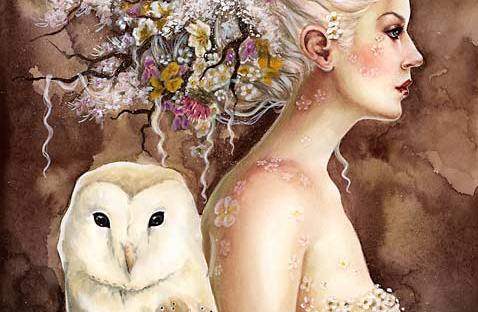
What were you expecting? A tame goddess who can be bribed with easy offerings? A pleasant springtime girl who asks for nothing but your adoration in return? An owl-feathered maiden of the forest to indulge your taste for the exotic and the dark? Were you hoping for a bedtime story with a moral at the end? Blodeuwedd's story isn't over. It is on-going. It is forever unfolding in every moment, in every place where nature and culture conflict and comingle, in every breath that weaves us as human animals into the more-than-human world. It would be too easy to approach Blodeuwedd through mythology and ritual alone, to disconnect her from the messy, erotic, death-riddled real world of broom blossoms and barred owls.