Today is Lughnasadh, and I find myself returning to the strange mixture of work and rest, grief and celebration that always marks this time of year for me. It is the acknowledgement of fear and loss during the most fruitful time of the year that marks this as a holy season. It is this mingling of love and sorrow, hope and grief that transforms the cycles of production and consumption into something more: a sacred harvest. When we forget the hard work of our ancestors, when we distance ourselves from the sweat, blood and tears that connect us to the living reality of those who have come before us, when we anesthetize ourselves to the grief we feel at the struggles they faced and the sacrifices they made — that is when we risk becoming mere consumers. Grief serves a sacred purpose, for we cannot grieve what we have not loved. Grief is one of the fruits of love, even as joy and prosperity are the fruits of labor.
Category: story
Daring to Dream: An Imbolc Family Adventure
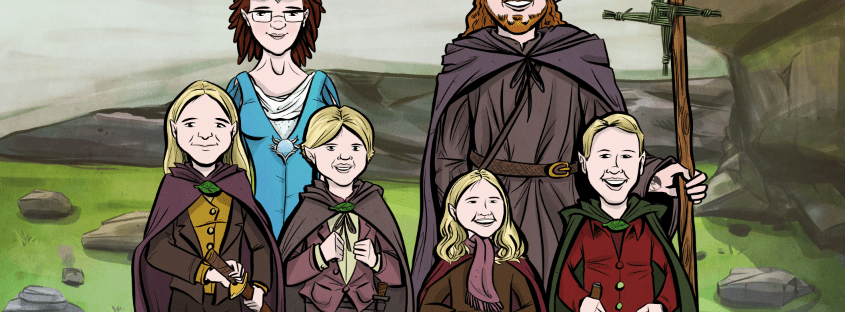
It all started this past winter solstice when Jeff's youngest daughter told us that she was going to be a dentist. Actually, what she said was that she guessed she'd have to be a dentist, because everybody knows you can't make a living as an artist. Our heads kind of exploded at that point, so what happened next was a bit of a blur. I vaguely remember sitting her down at the kitchen table and asking her why this sudden about-face -- she'd been talking about wanting to be an artist for the last several years which, for a nine-year-old, is almost a lifetime. I remember treading carefully, lest I inadvertently suggest that being a dentist wasn't perfectly okay, too, if that's what she really wanted. The world needs good dentists, after all. But what the world doesn't need is a grumpy, jaded dentist who's secretly always wanted to be an artist instead. That doesn't end well for anyone.
A Ha’penny Will Do: A Pagan Perspective on Christmas
As Christmas approaches once again, I find myself wondering, wandering in a liminal space. Asking myself how to teach children that realizing their own inner Santa Claus is infinitely more challenging than believing in some unlikely literal jolly-old-elf, and infinitely more rewarding. Asking myself where I belong, where we all belong, and how we belong to each other. Asking myself how I can tell the stories of my ancestors, pagan and Christian alike, to the children of my partner. What can I say that will be meaningful and relevant for them, that will share with them the "spirit of the season" that I have come to know and love and value? What will I say when they come singing, a penny for my thoughts?
Storytelling, Magic & Community
There is magic in good storytelling. In a world that can seem so woefully devoid of magic, we have a tendency to romanticize the writer, who is in touch with that magic in a deep, visceral way. But humans have been telling stories for as long as we've been human. Those who are lucky enough to call themselves professional writers have a particular set of skills and an admirable work ethic, but they don't hold the monopoly on good storytelling. The astrophysicist and the bank manager and the firefighter and the dairy farmer have stories of their own to tell. Storytelling at its root is a communal activity, something that can be shared by everyone. NaNoWriMo inspires us because it reminds us that storytelling is not about self-torture or perfectionism or asceticism, let alone popularity or profit. We can reclaim storytelling as basic human nature. We can recapture the creativity and imagination that is our birthright. We can push back against a society that would drain the world of its magic.
The Boy Who Cried Wolf
They say he did it out of boredom, but boredom is catching and soon the entire village had grown bored of his mischievous tricks. Each time he cried out that the wolf had come, and the villagers rushed to his aid only to discover no wolf in sight, they grew more annoyed, more disdainful — and more complacent...
Nobody Likes You Because You’re Perfect
"One day I am sweet, another day I am sour," says the Irish trickster god Manannan mac Lir in his guise as the disheveled traveling buffoon whose hat is full of holes and whose shoes squish with puddle water when he walks. Manannan appears in folktales sometimes as a buffoon and sometimes as a richly dressed bard of talent and renown. When he is a buffoon, his words are sweet and his music sweeter; when he is a master of his craft, he comes off as a fake and an ass. When he is at home, he is a king whose otherworldly castle is thatched with white birds' wings. But the half-thatched homes of the mortal bards will never be complete. While the poets are away gathering their feathers, the winds have already swept away the last day's work. Which is the real god? The king, the poet, or the wandering buffoon? Which is the real writer? Which is the real me?
The Writer’s Mating Dance
Between research and writing, there is a lacuna in which almost anything can happen. The hush is nearly unbearable. In my mental landscape, ideas rustle and nudge towards one another through the tall prairie grasses, their haunches twitching with tension, ready to flee. Eros is thick in the air. Ecology rubs up against ritual theory, playing with the hem of her skirt. Bruce Lincoln is making eyes at Lewis Hyde. The deer of my dreams raise their heads to listen hard for the hunter. The salmon of wisdom are working their way home. Any moment, I'm going to start writing. Any moment...
Why I Cannot Tell You About My Gods
When my friend Carl McColman says that language is tricky, and that God is bigger than the limits of the human mind, we might imagine our words are just so many rigged-up rubber bands, paper clips and packing tape with which we are, MacGyver-style, trying to capture a wild and mighty wind. Yet our words are our own breath given form by our body and its movements, and where else have we drawn that breath but from the winds themselves? Our speaking is a shaping of the wind within us, released back into the wild to work its way into someone else's body, moving with the ebb and flow of sound waves, pressing in against their eardrums, stirring the tiny hairs of their skin. To talk about language this way is to break out of the metaphor of objects and containers, and to see words as experiences in themselves.
It was a dark and stormy night…
It is from the east, now, that something new approaches the Byrnecock estate. Along the thin road bordered by hedgerows that cut across the hillsides come a pair of gaslit headlamps, illuminating with their amber light the slanting rain that dashes down through a plume of rising steam. The hedgerows have been thinned by the season to a tangle of bare limbs and would cast long, haunting shadows of grasping phantasms across the dampened earth if not for the low, dense clouds that so thoroughly blot out the moon. The thin, wide wheels of the carriage spin steadily despite the rain, hardly slipping across the slick track of mud and fallen leaves. There is no sad, sodden beast trotting along mournfully before this carriage, no sound of hoofbeats muffled by the wet autumn litter. Instead, a kind of wide, flat cart and on it, a large cylinder of dark metal that sizzles slightly in the downpour. The hiss and sigh of small pistons pumping a series of nested gears on either side quite drown out the low conversation of the occupants who sit, rigid and poised, casting slim silhouettes on the fogged window panes from the dry interior of the cab.
Tarot, NaNoWriMo and You
We're nearly a week into National Novel Writing Month, and I'm taking a break from writing The Fantastical Adventures of the Working Title to share a little bit about my process. Until a few weeks ago, when it came to fiction writing, I didn't have one. Enter: the Steampunk Tarot. Now my whole process takes about an hour, and I repeat it whenever my writing begins to slow down to a snail's pace and I find myself taking twenty minutes to describe the minute details of the brocade pillows on the chaise lounge where the heroine has been reclining awkwardly waiting for her narrator to realize nobody gives a shit about brocade pillows. Here's how it works.